Having a baby often means discovering just how many products are marketed as “essential.” From specialised pillows and fancy sleep gadgets to feeding accessories and travel products, it is easy to spend a lot of money before figuring out what you actually need.
The better approach is to start with practical products that solve everyday problems, are easy to clean, and can be used regularly as your baby grows.
This guide covers five baby-product categories that are worth considering for most families in India, along with what to look for, what to avoid, and when you actually need them.
Important: Babies have different needs depending on their age and development. Product recommendations should never replace advice from your pediatrician, particularly for feeding, sleep or health-related products.
Quick Look: 5 Baby Products Worth Buying
| Product category | Best for | When you’ll use it |
|---|---|---|
| 👶 Diapering essentials | Everyday baby care | From birth |
| 🍼 Feeding essentials | Bottle feeding & mealtimes | Depends on feeding method |
| 🛁 Bath & skincare products | Daily hygiene | From birth |
| 😴 Safe sleep essentials | Creating a safer sleep space | From birth |
| 🧸 Developmental toys & books | Play and learning | As baby grows |
The important point is that you don’t need to buy everything at once. Some products become useful only at a particular stage.
Top Picks for This Article
Handpicked from across DealPaglu — prices and offers may change.


Prime Deals Baby First Blocks Activity Toys Sorter Baby and Toddler Toy ABCD Learning Shape Alphabets Storage Bucket Toys Sorting Game Developmental Educational Toy Children 16 Building Blocks
1. Diapering Essentials
Diapers are one of the few baby purchases that quickly become part of your daily routine.
But the diaper itself isn’t the only thing worth having. A simple diapering setup can make changes considerably easier, especially during the first few months.
What to buy
A practical diapering setup can include:
- Disposable or reusable diapers
- Baby wipes or soft cotton cloth
- Changing mat
- Diaper rash cream
- Waterproof changing-pad covers
- Small bags or a dedicated bin for used diapers
What to look for in diapers
Don’t automatically assume the most expensive diaper is the best.
Look for:
Good fit:
The diaper should fit snugly around the waist and legs without leaving deep marks.
Absorbency:
Especially important for overnight use.
Softness:
The inner material should feel comfortable against your baby’s skin.
Leak protection:
Look for designs with secure leg cuffs and a good waistband.
Correct size:
Don’t buy a huge stock of one size just because it is cheaper per diaper. Babies can move through sizes surprisingly quickly.
Is a changing table necessary?
Not necessarily.
A washable changing mat placed on a safe, stable surface can be enough for many homes. The important thing is to never leave a baby unattended on an elevated changing surface.
Worth buying?
Yes. Diapers, wipes/cotton cloth and a changing mat are among the most practical baby purchases.

Amazon Brand - Supples Premium Baby Diaper Pants | 66 Baby Diapers | XXXL | 18-35 Kg | 12 Hrs Absorption | Cushiony Cotton Soft Fabric | Phthalates-Free | Triple Leak Guard | 22 Count, Pack of 3
Shop Amazon Brand - Supples Premium Baby Diaper Pants | 66 Baby Diapers | XXXL | 18-3 at 63% off on Amazon. Best Baby Products deals & discounts.
2. Feeding Essentials
Feeding products depend heavily on how you feed your baby.
For newborns, some families may need bottles and sterilising equipment, while exclusively breastfeeding families may need very little feeding equipment initially.
As babies grow and start eating complementary foods, however, feeding accessories become much more useful.
Around 6 months, babies can generally begin complementary foods when they show the appropriate developmental readiness.
Useful products
Depending on your baby’s stage, consider:
- Feeding bottles
- Bottle brush
- Sterilising equipment
- Bibs
- Baby spoons
- Suction or stable bowls
- Training/open cup
- High chair or suitable feeding seat
What makes a good baby feeding product?
Look for products that are:
- Easy to clean
- Made from reputable food-contact materials
- Appropriately sized for babies
- Dishwasher-safe where applicable
- Free from unnecessary complicated parts
For starting solids, simple products are often better than elaborate feeding sets.
A small spoon, suitable bowl, bib and eventually a cup can accomplish a lot.
The CDC recommends offering foods appropriate to a baby’s developmental eating skills, including soft, appropriately sized foods as babies progress.
One important reminder
Don’t buy feeding products based on the assumption that your baby needs solids very early.
The CDC notes that complementary foods are generally introduced at about 6 months, rather than before 4 months. (CDC)
Worth buying?
Yes, but buy according to age.
There is little reason to purchase an entire feeding collection for a newborn who isn’t ready for solids.
OCEANEVO Cute Felt Diaper Caddy Organizer Bag with Lid and Removable Shoulder Strap | Baby Basket Essentials for Newborn Baby Products Storage with Compartments | 40 x 27 x 19 cm | Model 2 – Beige
Feeding products depend heavily on how you feed your baby. For newborns, some families may need bottles and sterilising equipment, while exclusively…
3. Baby Bath & Skincare Essentials
Baby skincare can become another category where parents end up buying far more than necessary.
You don’t need a bathroom full of specialised products.
A basic setup can cover most everyday needs.
What to buy
Consider:
- Mild baby cleanser
- Soft towels
- Washcloths
- Baby nail clipper/file
- Moisturiser if needed
- A small baby bathtub if it makes bathing easier
What to look for
Choose products with:
Simple formulations:
More ingredients don’t automatically mean a better product.
Baby-appropriate use:
Check the recommended age and instructions.
Easy washing:
Towels and washcloths should be easy to wash frequently.
Good grip:
If buying a baby bathtub, stability is more important than fancy features.
Don’t overbuy skincare
A common mistake is purchasing several lotions, oils, powders and creams before knowing whether your baby’s skin actually needs them.
Start with the basics and add products only when there is a genuine need.
If your baby develops persistent irritation, eczema-like symptoms or another skin problem, talk to your pediatrician rather than repeatedly switching cosmetic products.
Worth buying?
Yes, but keep it simple.
BRONTIX 4 in 1 Sterilizer and Dryer for Feeding Bottles with Cleaning Set, Sterilizer for Baby Products, Bottle Sterilizer & Baby Bottle Sterilizer
Baby skincare can become another category where parents end up buying far more than necessary. You don’t need a bathroom full of specialised products. A…
4. Safe Sleep Essentials
This is the category where safety should come before convenience or appearance.
Parents will find products marketed as baby nests, loungers, positioners, wedges, sleep pillows and specialised mattresses.
More expensive does not necessarily mean safer.
The American Academy of Pediatrics recommends placing babies on their backs for sleep on a firm, flat, non-inclined sleep surface.
What you actually need
A basic safe sleep setup can include:
- Safety-compliant crib, bassinet or suitable portable sleep space
- Firm, flat mattress designed for that product
- Fitted sheets
- Appropriate baby sleepwear or wearable blanket when needed
What should stay out of the sleep space?
Avoid putting loose items around a sleeping baby, including:
- Pillows
- Loose blankets
- Quilts
- Stuffed toys
- Bumpers
- Sleep positioners
- Other soft objects
AAP guidance specifically warns against products such as inclined sleepers and sleep positioners that don’t follow safe-sleep recommendations. (AAP)
What about baby monitors?
A monitor can be useful for convenience and peace of mind, but don’t buy a device because its marketing suggests it can prevent SIDS.
The AAP notes that home cardiorespiratory monitors have not been shown to reduce SIDS risk.
Worth buying?
Absolutely, but prioritise safety rather than gadgets.
This is one area where checking the product’s safety information and specifications is more important than chasing features.
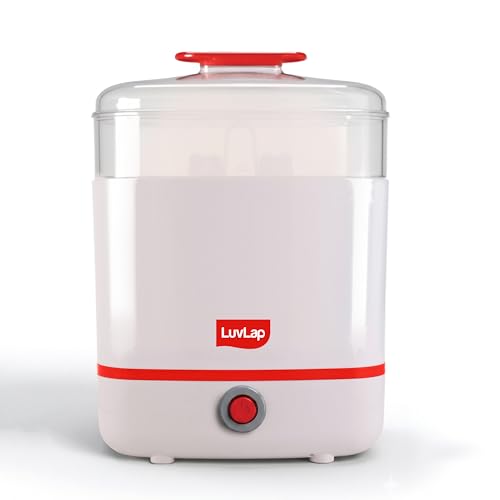
LuvLap 3-in-1 Electric Steam Sterilizer, Sterlizer for Baby Products, Kills 99.9% Germs, 8 Minutes Superfast Sterilization, Keeps Items sterile for up to 24 Hours*
This is the category where safety should come before convenience or appearance . Parents will find products marketed as baby nests, loungers, positioners…
5. Developmental Toys & Books
Babies don’t need a huge toy collection.
In fact, some of the most useful early toys are remarkably simple.
The goal isn’t to keep a baby entertained every minute. Toys can provide opportunities to practise skills such as reaching, grasping, looking, exploring textures and eventually manipulating objects.
Good products to consider
Depending on age:
- Cloth books
- Board books
- Rattles
- Soft blocks
- Stacking cups
- Simple shape toys
- Activity mats
- Teething toys designed for babies
What makes a good baby toy?
Look for:
Age suitability:
Follow the manufacturer’s recommended age range.
No small detachable parts:
Anything that could become a choking hazard should be avoided.
Easy to clean:
Babies put almost everything in their mouths.
Simple design:
A toy doesn’t need lights, sounds and a dozen electronic modes to be useful.
Books are an underrated purchase
A small collection of sturdy board or cloth books can be useful for interaction, language exposure and establishing a reading routine.
You don’t need dozens.
Even a few age-appropriate books that parents regularly read with the baby can become part of everyday play.
Worth buying?
Yes. Prioritise simple, age-appropriate toys and books over large toy collections.
Storio Baby Products Toys 7 Pcs Rattle Set with Teathers for New Born Baby Gifts, Toy for Babies, Non-Toxic
Babies don’t need a huge toy collection. In fact, some of the most useful early toys are remarkably simple. The goal isn’t to keep a baby entertained…
What Baby Products Should You NOT Buy?
One of the best ways to save money is to recognise that “baby product” doesn’t automatically mean “baby essential.”
Before buying something, ask:
1. Will we use it regularly?
If the answer is probably once or twice, consider borrowing or skipping it.
2. Does it solve an actual problem?
A product that makes an everyday task easier can be worthwhile.
A product that simply adds another step probably isn’t.
3. Can it be cleaned easily?
This is particularly important for feeding, bathing and toys.
4. Is it appropriate for my baby’s age?
Don’t buy something months in advance just because it is on sale.
5. Does the product have unnecessary safety risks?
This is especially important for sleep products.
A beautiful-looking product isn’t worth buying if it conflicts with established safe-sleep recommendations.
Baby Buying Guide: What to Buy First
If you’re preparing for a newborn, you don’t need to purchase everything on your shopping list immediately.
Before the baby arrives
Prioritise:
- Diapers
- Changing mat
- Basic clothing
- Basic bath supplies
- Safe sleep space
- Feeding supplies appropriate to your feeding plan
- A few simple toys/books
0 to 3 months
Focus on:
- Diapering
- Feeding
- Bathing
- Safe sleep
- Basic clothing
- Simple sensory interaction
Around 6 months
This is when additional products can become useful, particularly:
- Feeding spoons
- Baby bowls
- Bibs
- Cups
- High chair
- Age-appropriate toys
- Soft finger-food feeding accessories
The transition to complementary foods should follow your baby’s developmental readiness rather than simply their age on a calendar. (CDC)
How to Save Money on Baby Products
Baby products can become expensive surprisingly quickly.
A few simple strategies can keep your spending under control.
Buy fewer, better-used products
Instead of buying five different bottles, start with what you actually need and see what works for your baby.
Don’t stockpile diapers
Buy enough to get started, then adjust the size and brand based on fit and your baby’s needs.
Buy age-appropriate products
There’s little benefit in buying toys or feeding equipment months before they’ll be used.
Compare replacement costs
A cheap product that needs replacement every few months may cost more than a durable product.
Look for products that serve multiple purposes
A simple washable mat, for example, can be useful in several parts of your baby’s routine.
Final Verdict: What Are the 5 Baby Products Worth Buying?
If you want to keep your baby shopping list practical, start with these five categories:
1. Diapering essentials
Daily-use products that you’ll quickly rely on.
2. Feeding essentials
Buy according to your baby’s current feeding stage.
3. Bath & skincare essentials
Keep the routine simple and avoid unnecessary products.
4. Safe sleep essentials
Prioritise a firm, flat, safe sleep surface over fancy sleep gadgets.
5. Developmental toys & books
Choose simple, age-appropriate products that encourage interaction and exploration.
The biggest takeaway is simple: you don’t need every product marketed to new parents.
Build your baby’s collection gradually. Buy for the stage your baby is actually in, prioritise safety and usability, and spend more on products that you’ll use every day.
That approach can make baby shopping less overwhelming, more affordable and much more practical.
Editor’s Note
This guide is intended for general product-buying information and is not medical advice. For questions about your baby’s feeding, sleep, development, allergies or health, consult a qualified pediatrician.