Choosing one laptop for video editing, AI tools, coding and website development is harder than choosing a machine for everyday office work. These workloads can involve compiling code, running multiple browser tabs, using development environments, editing high-resolution footage and working with demanding creative software.
For this kind of mixed usage, RAM, processor performance, SSD capacity and graphics capability matter more than simply buying the newest-looking laptop.
The three laptops below are based on the Amazon India listings provided for comparison. Their listed configurations and customer ratings are included where available. Current pricing and stock status could not be reliably verified from the supplied listing data, so check the Amazon listing before purchasing.
Quick Recommendations
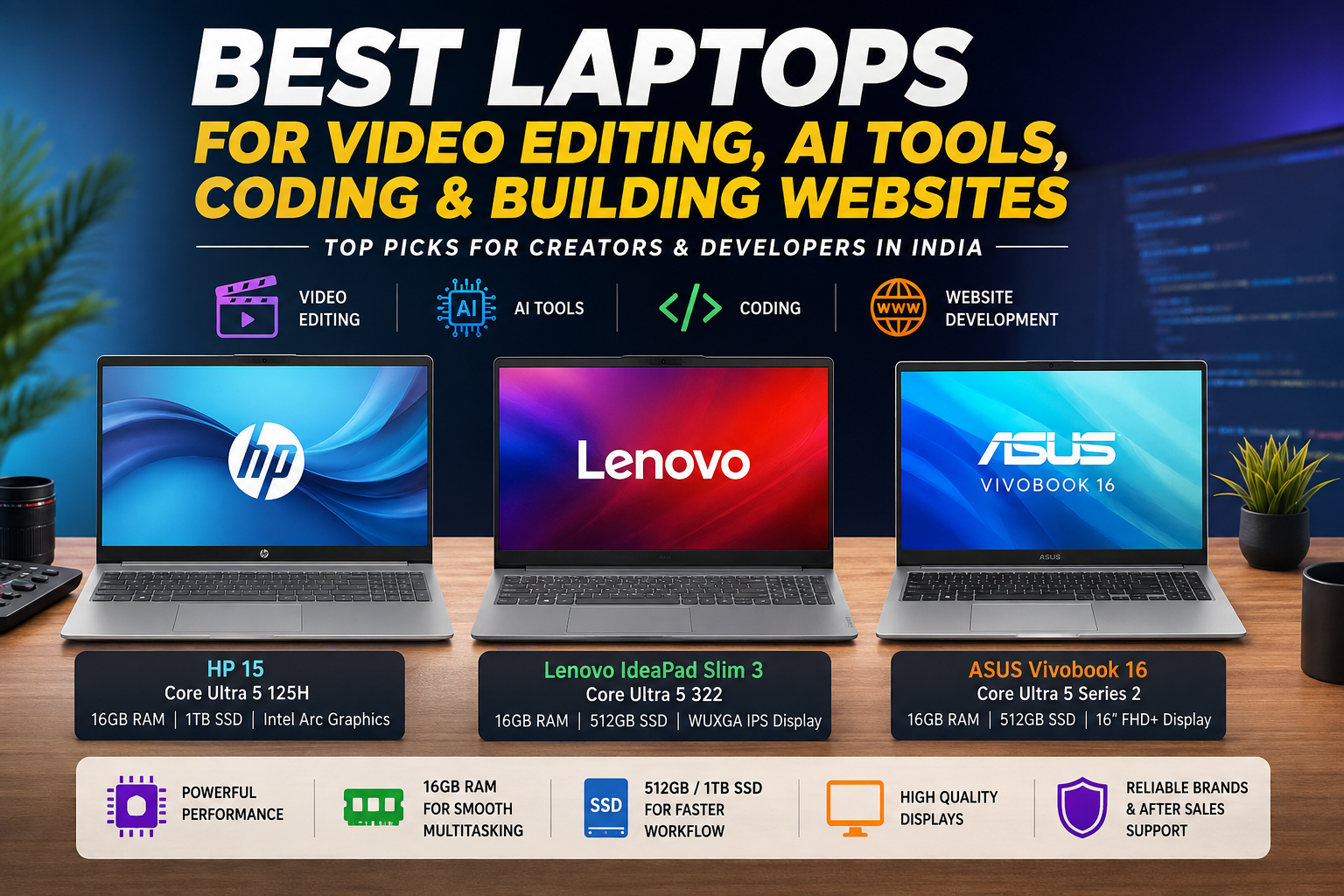
| Laptop | Processor | RAM / Storage | Graphics | Rating | Availability | Best suited to |
|---|---|---|---|---|---|---|
| HP 15, Core Ultra 5 125H | Intel Core Ultra 5 125H | 16GB / 1TB SSD | Intel Arc Graphics | 3.9/5 from 427 reviews | Availability could not be reliably verified | Video editing + coding + general development |
| Lenovo IdeaPad Slim 3, Core Ultra 5 322 | Intel Core Ultra 5 322 | 16GB / 512GB SSD | Integrated graphics | 4.0/5 from 19 reviews | Availability could not be reliably verified | Coding, websites and productivity |
| ASUS Vivobook 16, Core Ultra 5 | Intel Core Ultra 5 Series 2 | 16GB / 512GB SSD | Intel integrated graphics | 3.9/5 from 68 reviews | Availability could not be reliably verified | Large-screen coding and everyday development |
Short verdict: Among these three, the HP 15 with Core Ultra 5 125H, 16GB RAM, 1TB SSD and Intel Arc Graphics is the most compelling configuration for someone combining video editing with coding and website development. The Lenovo and ASUS options make more sense when coding, browser-based AI tools and general productivity are the priority.
What Should You Look For?
Before choosing a laptop for these workloads, focus on the components that actually affect your day-to-day experience.
Processor
A modern multi-core processor is important for:
- Code compilation
- Running development environments
- Video rendering
- Compressing and exporting files
- Running multiple applications simultaneously
- Heavy browser workloads
For a mixed-use machine, a modern Core Ultra 5-class processor is a sensible starting point.
RAM
16GB RAM should be considered the practical starting point for this type of laptop.
Coding itself may not require huge amounts of RAM, but things change when you have:
- VS Code or another IDE open
- Multiple browser tabs
- Local development servers
- Photoshop or video-editing software
- Music or communication applications
- AI tools running in the browser
A laptop with 16GB gives considerably more breathing room than a basic 8GB configuration.
SSD Storage
Video projects can consume storage quickly.
A 512GB SSD can work for coding and web development, but a 1TB SSD is considerably more convenient if you regularly keep video footage, project files, applications and development environments on the laptop.
This is one reason the HP configuration stands out in this comparison.
Graphics
This is the most important distinction between a general-purpose laptop and a serious video-editing machine.
Integrated graphics can handle basic editing and many everyday creative workloads, but demanding effects, high-resolution timelines, 3D work and GPU-heavy applications can benefit substantially from a dedicated graphics processor.
The laptops in this comparison use Intel integrated/Arc graphics rather than a dedicated NVIDIA GeForce GPU.
Therefore, if your definition of video editing includes heavy 4K editing, complex effects, 3D rendering or professional GPU-accelerated workflows, you should look beyond these three configurations and consider a laptop with a dedicated GPU.
HP 15 with Core Ultra 5 125H
The HP 15 has the most interesting configuration of the three for someone who wants to combine creative work with development.
Its listed configuration includes:
- Intel Core Ultra 5 125H
- 16GB DDR5 RAM
- 1TB SSD
- 15.6-inch FHD IPS display
- Intel Arc Graphics
- Windows
- FHD camera with privacy shutter
- Approx. 1.65kg listed weight
The 16GB DDR5 + 1TB SSD combination is particularly useful for developers and video editors. You have enough memory for a reasonably heavy multitasking workload while the larger SSD gives you more room for project files.
The Intel Arc Graphics also make this configuration more interesting for creative workloads than a basic office laptop with a weaker integrated graphics solution.
Strengths
- 16GB DDR5 RAM
- 1TB SSD
- Core Ultra 5 125H processor
- Intel Arc Graphics
- Relatively manageable 1.65kg listed weight
- FHD IPS display
- FHD camera with shutter
Limitations
The biggest limitation is the lack of a dedicated GPU. If you work extensively with demanding effects, 3D rendering or complex high-resolution video projects, a dedicated-GPU laptop would be a better direction.
The supplied Amazon listing shows a 3.9/5 rating from 427 reviews, giving this model considerably more customer feedback than the Lenovo and ASUS listings in this comparison.
Who should buy it?
Choose this HP if your workload is a mixture of coding, website development, browser-based AI tools, content creation and moderate video editing.
Who should skip it?
Skip it if your primary purpose is professional 4K video production, 3D work or other workloads that depend heavily on dedicated GPU performance.
Check the latest listing on Amazon
Lenovo IdeaPad Slim 3 with Core Ultra 5 322
The Lenovo IdeaPad Slim 3 takes a more productivity-focused approach.
Its listed configuration includes:
- Intel Core Ultra 5 322
- 16GB RAM
- 512GB SSD
- 15.3-inch WUXGA IPS display
- Integrated graphics
- Windows
- Backlit keyboard
- Approx. 1.6kg listed weight
The 15.3-inch WUXGA IPS display gives developers a useful working area, while the backlit keyboard is handy if you regularly code at night.
The 16GB RAM is also appropriate for running an IDE alongside browsers, development tools and other applications.
Strengths
- 16GB RAM
- WUXGA IPS display
- Backlit keyboard
- 512GB SSD
- Around 1.6kg listed weight
- Core Ultra processor
- Designed around general productivity and AI-PC features
Limitations
The 512GB SSD is adequate for coding and website projects but less comfortable for people who maintain large video libraries.
Its integrated graphics also make it less suitable for demanding video editing than a laptop equipped with a dedicated GPU.
The supplied listing shows a 4.0/5 rating from 19 reviews, but the review volume is much smaller than the HP listing.
Who should buy it?
This makes more sense if your priority is coding, website development, browser-based AI tools, office work and general multitasking, with video editing being occasional rather than your primary workload.
Who should skip it?
Consider another configuration if you regularly work with large video projects or need strong GPU performance.
Check the latest listing on Amazon
ASUS Vivobook 16
The ASUS Vivobook 16 is the largest-screen option among these three laptops.
Its listed configuration includes:
- Intel Core Ultra 5 Series 2 processor
- 16GB RAM
- 512GB SSD
- 16-inch FHD+ display
- Intel integrated graphics
- Windows
- Office software
- Approx. 1.88kg listed weight
The 16-inch display is useful for coding because you can keep your editor, terminal and browser visible with less need to constantly switch windows.
It can also be comfortable for general content work and multitasking.
Strengths
- Large 16-inch display
- 16GB RAM
- 512GB SSD
- Core Ultra processor
- Suitable for coding and browser-based workloads
- Listed weight of approximately 1.88kg
Limitations
The biggest concern for a video-editing-focused buyer is the Intel integrated graphics.
The 512GB SSD is also less convenient than a 1TB drive if you store substantial amounts of video footage locally.
The supplied Amazon listing shows a 3.9/5 rating from 68 reviews.
Who should buy it?
Consider it if you value a large screen for coding, website development, browsing and multitasking and only perform occasional or relatively light video editing.
Who should skip it?
Skip this configuration if GPU performance and large local video storage are high priorities.
Check the latest listing on Amazon
Which Laptop Is Better for Video Editing?
For video editing, the HP has the most attractive configuration among these three.
The reason is not simply the processor. The combination of 16GB DDR5 RAM, 1TB SSD and Intel Arc Graphics gives it a more suitable balance for creative workloads.
However, there is an important distinction.
If you mainly edit:
- Short-form videos
- YouTube videos
- 1080p footage
- Basic social-media content
- Simple cuts and transitions
- Moderate effects
the HP configuration is the more sensible choice here.
If you regularly work with:
- Complex 4K timelines
- Heavy colour grading
- Multiple GPU-intensive effects
- 3D rendering
- Advanced motion graphics
look for a laptop with a dedicated GPU rather than choosing solely among these three.
Which Laptop Is Better for Coding?
All three can make sense for coding because each configuration provides 16GB RAM and a modern Core Ultra processor.
The decision comes down to how you work.
The Lenovo IdeaPad Slim 3 is attractive for a developer who prioritises a WUXGA IPS display, backlit keyboard and portability.
The ASUS Vivobook 16 makes sense if you want a larger 16-inch screen for coding and multitasking.
The HP 15 has the advantage of 1TB storage, which can be useful if you work with multiple repositories, virtual environments, local development tools and other large files.
What About AI Tools?
There are two very different meanings of “AI laptop”.
Browser-based AI tools
If you primarily use AI through websites and cloud services, your laptop does not need a powerful local AI accelerator for every task.
A capable processor, 16GB RAM and a good SSD are more important for keeping your overall workflow responsive.
All three laptops can therefore fit a workflow involving browser-based AI tools alongside coding and web development.
Running AI models locally
Local AI is a different requirement.
If you plan to run sizeable AI models directly on the laptop, GPU memory and dedicated GPU performance become much more important.
In that situation, these integrated-graphics configurations should not be treated as substitutes for a dedicated-GPU laptop.
Building Websites on These Laptops
Website development is generally less demanding than professional video editing.
A 16GB laptop can comfortably be used for a workflow involving:
- VS Code
- Web browsers
- HTML and CSS
- JavaScript
- React or other frameworks
- Git
- Local development servers
- Database tools
- API testing
- Image-editing tools
- AI coding assistants
The main thing to watch is multitasking.
A developer may have an IDE, several browser windows, local servers, documentation, terminal sessions and communication applications open simultaneously. That is why 16GB RAM is a much better starting point than choosing a cheaper 8GB laptop.
512GB vs 1TB SSD
For this particular use case, the difference is important.
512GB SSD
Good for:
- Coding
- Web development
- Office work
- Browser-based AI tools
- General applications
- Smaller creative projects
But available space can disappear quickly after installing development software and storing video projects.
1TB SSD
More suitable for:
- Video editing
- Large coding projects
- Multiple development environments
- Local media libraries
- Large application installations
- Keeping several projects on the laptop
This gives the HP an advantage for the mixed workload described in this article.
Common Buying Mistakes
Buying based only on the processor name
A good processor does not automatically make a laptop suitable for professional video editing.
Check the GPU, RAM, storage and display as well.
Choosing 8GB RAM to save money
For basic browsing, 8GB may be usable, but coding plus browsers plus creative applications can quickly push memory usage higher.
For this workload, 16GB is a much safer starting point.
Ignoring GPU requirements
If video editing is your main workload, do not assume that a modern processor’s integrated graphics are equivalent to a dedicated GPU.
They are not.
Buying a small SSD
Video footage and project files can consume hundreds of gigabytes surprisingly quickly.
If you edit videos regularly, 1TB is much more comfortable than 512GB.
Treating an AI badge as proof of powerful local AI
AI-related branding does not automatically mean that a laptop can efficiently run large AI models locally.
For local AI, investigate the actual GPU, VRAM and software requirements for the models you intend to run.
Final Verdict
If you need one laptop for video editing, AI tools, coding and building websites, the HP 15 with Core Ultra 5 125H, 16GB DDR5, 1TB SSD and Intel Arc Graphics is the strongest fit among the three configurations supplied.
Its combination of 16GB RAM and 1TB storage makes it particularly practical for developers who also work with media files, while Intel Arc Graphics give it a more capable graphics setup than a basic integrated-GPU laptop.
The Lenovo IdeaPad Slim 3 is a better fit when coding and productivity are more important than video editing, while the ASUS Vivobook 16 is worth considering if a larger display is a priority.
However, there is one important caveat: none of these should be your first choice for serious GPU-heavy video editing or local AI workloads. For those tasks, move up to a laptop with a dedicated NVIDIA or AMD GPU and sufficient VRAM.
Top Picks for This Article
Handpicked from across DealPaglu — prices and offers may change.